
Post
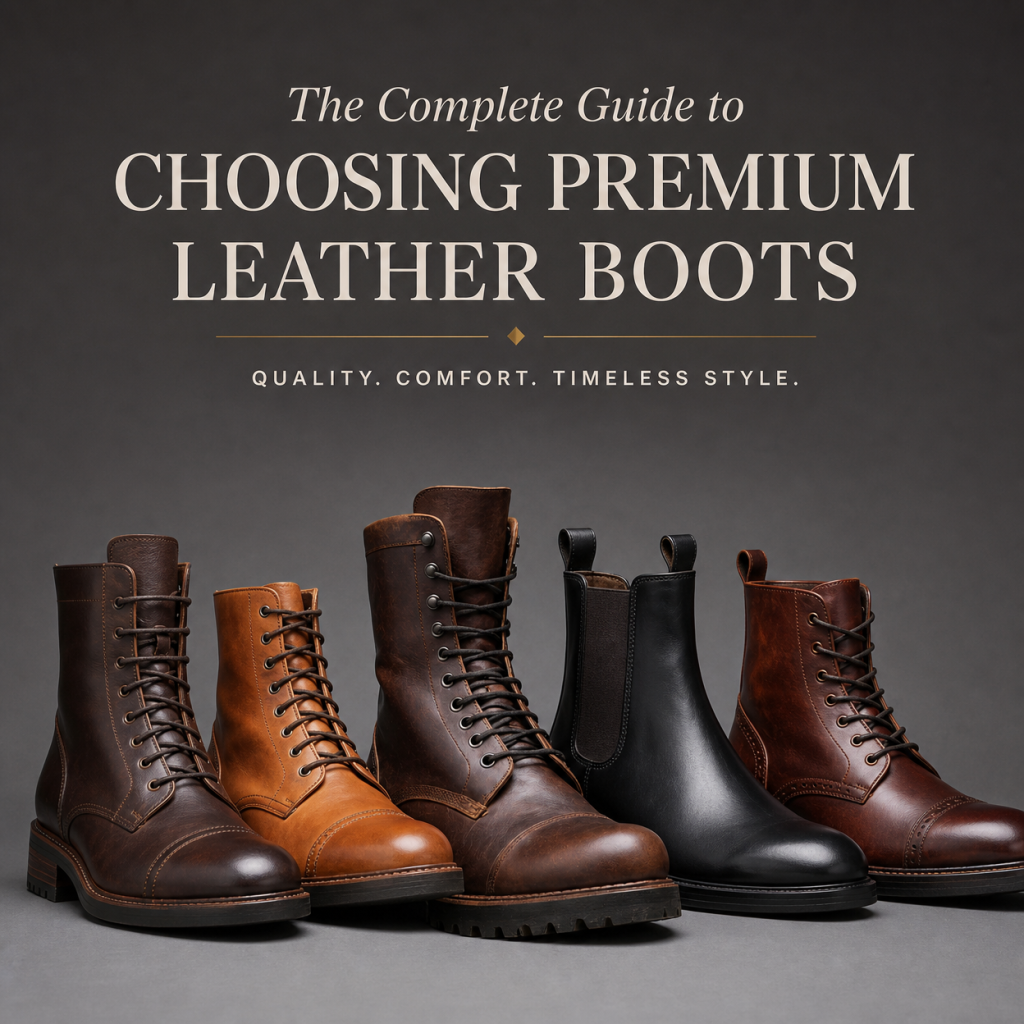
The Complete Guide to Choosing Premium Leather Boots
May
The Complete Guide to Choosing Premium Leather Boots
Leather boots sit in a unique category of footwear. They’re not just seasonal fashion pieces or disposable items—they can be long-term assets when chosen correctly. A well-made pair can last decades, adapt to your lifestyle, and even improve in appearance over time. But that only happens if the right decisions are made at the beginning.
Choosing premium leather boots is less about trends and more about understanding materials, construction, fit, and purpose. Once you know what actually matters, it becomes much easier to separate real quality from marketing noise.
1. Start With Purpose: Why You Need the Boots
Before looking at leather type or brand, the first question is simple: what will you actually use them for?
Different uses require different designs:
- Daily casual wear → comfort and versatility
- Office or smart-casual → clean silhouette, refined finish
- Outdoor or hiking → traction, support, weather resistance
- Work environments → durability and protection
- Fashion-focused styling → design and aesthetics
A premium boot is not just “expensive”—it is appropriate for its purpose.
Choosing the wrong type often leads to discomfort or premature wear, even if the boot itself is high quality.
2. Leather Quality: The Foundation of Premium Boots
Leather is the most important material in the leather boots. Its grade determines how the boot behaves over time.
Full-Grain Leather: The Highest Standard
Full-grain leather is considered the top tier.
It uses the entire outer layer of the hide, without sanding or surface correction.
Key characteristics:
- Strongest natural fiber structure
- Visible natural grain and texture
- Unique marks and imperfections
- Excellent durability
- Best patina development over time
Instead of wearing out, it evolves. Over years, it becomes softer, richer in color, and more characterful.
This is the preferred choice for true long-term investment boots.
Top-Grain Leather: Refined and Practical
Top-grain leather is slightly processed by sanding the surface to remove imperfections.
It offers:
- Smoother, more uniform appearance
- Good durability
- More controlled aesthetic look
- Slightly softer feel from the start
However, because the top natural layer is altered, it does not develop patina as dramatically as full-grain leather.
It is often used in premium fashion boots where appearance consistency matters.
Corrected-Grain and Lower Grades
Corrected-grain leather is heavily processed and stamped with artificial texture.
It provides:
- Uniform appearance
- Lower cost
- More synthetic-like finish
But it sacrifices:
- Breathability
- Natural aging
- Long-term character development
It is suitable for budget or fashion-focused boots, but not long-term investment footwear.
3. Construction Method: The Hidden Structure of Quality
Even the best leather boots will fail if construction is poor. This is where premium leather boots truly separate themselves from mass-market footwear.
Goodyear Welt Construction: The Gold Standard
Goodyear welt construction is one of the most respected methods in bootmaking.
It works by:
- Stitching the upper leather to a welt (a strip of leather)
- Stitching the welt to the sole
- Creating a layered, repairable structure
Benefits include:
- High durability
- Water resistance improvement
- Excellent structural stability
- Easy resoling without damaging the upper
This is why welted boots often last for decades instead of years.
Other Construction Types
- Blake Stitching: more flexible and lightweight, but less water-resistant
- Cemented Construction: glued soles, common in cheaper boots, not easily repairable
For premium boots, welted construction is strongly preferred because it supports long-term use and maintenance.
4. Fit: The Most Overlooked Factor
Even the highest quality boot becomes useless if it does not fit correctly.
Proper fit should consider:
- Length (toe space without pressure)
- Width (no tight squeezing or excessive movement)
- Arch support alignment
- Heel stability
A well-fitting boot should feel snug but not painful. Some initial tightness is normal, but sharp pressure points are not.
Premium boots also break in over time, gradually molding to the shape of your feet.
5. Comfort and Internal Structure
Comfort in leather boots is not just about softness—it comes from engineering inside the boot.
Key elements include:
- Insole cushioning
- Arch support structure
- Lining material (leather or fabric)
- Heel support design
High-quality boots often improve in comfort over time, unlike cheap footwear that degrades with use.
A premium boot should feel better after weeks of wear, not worse.
6. Sole Type: Performance and Longevity
The sole is where durability and functionality meet.
Leather Soles
- Classic appearance
- Breathable
- Suitable for formal wear
- Less grip in wet conditions
Rubber Soles
- Better traction
- More durability in rough conditions
- Ideal for outdoor or daily use
Hybrid Soles
- Combine leather + rubber
- Balance aesthetics and function
A premium boot matches sole type to intended use instead of using a one-size-fits-all approach.
7. Craftsmanship Details That Matter
True premium boots reveal their quality in small details:
- Even stitching with consistent spacing
- Clean edge finishing
- Solid eyelets and hardware
- Symmetry in construction
- No glue overflow or rough edges
These details may seem minor, but they indicate how carefully the boot was made.
High-end manufacturers maintain strict quality control at every stage.
8. Brand Philosophy: Why It Matters
Different regions and brands approach bootmaking differently:
- Italy → style and elegance
- England → tradition and longevity
- Germany → performance and engineering
- Spain → balance of value and craftsmanship
- USA → rugged durability
A “premium” boot is not only defined by materials, but also by the philosophy behind its creation.
Understanding this helps you choose boots that align with your lifestyle.
9. Price vs Value: Thinking Long-Term
Premium boots are expensive for a reason—but price alone does not define value.
A true investment boot should:
- Last many years (or decades)
- Be repairable (resole, heel replacement)
- Age well instead of degrading
- Maintain comfort over time
A cheaper boot replaced multiple times often costs more in the long run than one high-quality pair.
10. Maintenance: Protecting Your Investment
Even the best boots require care.
Basic maintenance includes:
- Regular cleaning to remove dirt
- Conditioning to prevent drying
- Waterproofing in wet climates
- Proper storage with shape support
Well-maintained boots can last significantly longer than neglected ones of the same quality.
Conclusion
Choosing premium leather boots is a combination of knowledge and intention. It is not just about picking the most expensive option or the most attractive design—it is about understanding what makes a boot truly high quality.
The best boots combine:
- High-grade leather (preferably full-grain)
- Durable construction (such as Goodyear welt)
- Proper fit and comfort engineering
- Purpose-driven design
- Long-term repairability
When these elements come together, a pair of boots stops being a simple purchase and becomes a long-term companion.
In the end, premium leather boots are not defined by how they look on day one, but by how they perform, age, and support you over years of real use.
