
Post
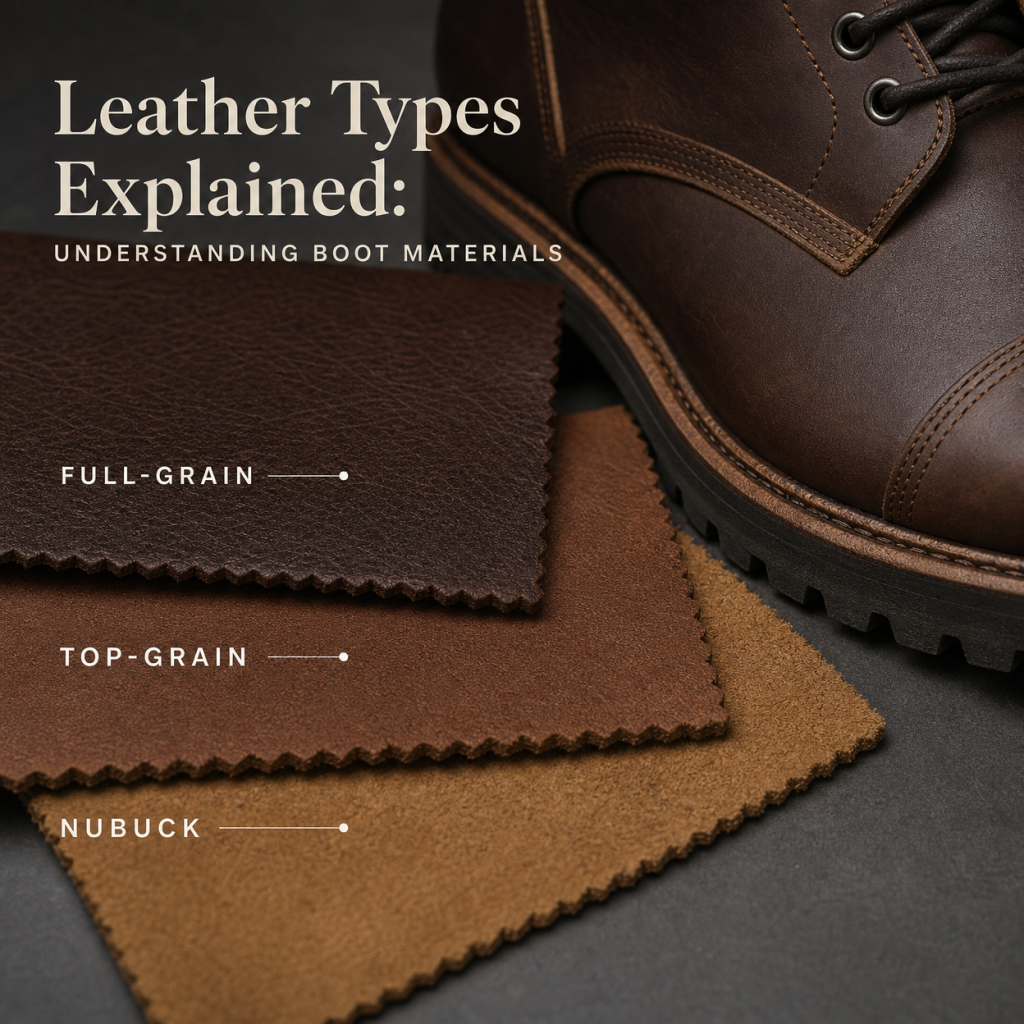
Leather Types Explained: Understanding Boot Materials
May
Leather Types Explained: Understanding Boot Materials
Not all leather is created equal, and in the world of boots, the type of leather used can completely change how a pair performs, looks, and ages over time. Two boots may look nearly identical when new, yet one lasts decades and develops rich character while the other cracks, fades, or loses structure within a few years.
Understanding leather types helps you move beyond surface appearance and evaluate what you’re actually paying for. It affects durability, comfort, breathability, maintenance needs, and long-term value. In short, leather type determines whether your boots are a long-term investment or a short-term purchase.
Why Leather Type Matters in Boots
Leather is not a uniform material. It is made from animal hide, and different layers of that hide have different strengths and qualities. On top of that, manufacturers process leather in different ways to achieve certain looks or price points.
These differences directly impact:
- Durability and lifespan
- Comfort and flexibility
- Breathability and moisture control
- Appearance over time
- Ability to develop patina
- Repair and maintenance potential
A strong understanding of leather types helps you choose boots that match your real needs instead of just their appearance in a store or online photo.
Full-Grain Leather: The Highest Quality Standard
Full-grain leather is widely considered the best leather available for boots.
What It Is
Full-grain leather comes from the top outer layer of the hide, and it is left completely unaltered. It is not sanded, buffed, or corrected in any way, meaning the original surface remains intact.
This allows it to preserve:
- Natural grain structure
- Original surface texture
- Scars, wrinkles, and imperfections from the animal
- Full strength of the fiber layer
Rather than being “perfect,” full-grain leather is authentic.
Natural Marks and Why They Matter
In full-grain leather, natural markings are not defects. Instead, they are part of what makes each piece unique.
These include:
- Small scars
- Grain variations
- Texture differences
- Natural color variation
Instead of reducing value, these details:
- Prove authenticity
- Add visual depth
- Create individuality in every pair
No two full-grain leather boots ever age or look exactly the same.
Durability and Strength
Full-grain leather is extremely durable because:
- The strongest fiber layer is untouched
- Natural structure remains intact
- Fibers are densely packed
This results in:
- Excellent resistance to wear and tear
- Long lifespan under daily use
- Strong structural integrity over time
It is commonly used in high-end boots designed for long-term wear and repairability.
Aging and Patina Development
One of the biggest advantages of full-grain leather is how it ages.
Instead of degrading, it improves visually through a process called patina development.
Over time, full-grain Leather Types :
- Darkens or deepens in color
- Gains natural shine in high-wear areas
- Develops unique creasing patterns
- Becomes softer but stronger
This aging process is gradual and highly desirable, especially for enthusiasts who value character over perfection.
Trade-Offs of Full-Grain Leather
While it is the highest quality, it comes with some considerations:
- Higher cost compared to other leather types
- Requires proper care and maintenance
- Shows natural imperfections more visibly
However, its long lifespan and aging quality often make it the best long-term investment.
Top-Grain Leather: Smooth and Refined
Top-grain Leather Types is the second-highest grade commonly used in quality boots.
What It Is
Top-grain leather is created by:
- Removing the outermost layer of the hide
- Sanding away natural imperfections
- Refining the surface for uniformity
This results in a cleaner, more controlled appearance.
Appearance Characteristics
Top-grain leather is often chosen for its aesthetic consistency. It provides:
- Smooth surface texture
- More uniform color
- Fewer visible natural marks
- Refined, polished look
This makes it popular in fashion-forward boots where visual cleanliness is prioritized.
Performance and Strength
Top-grain Leather Types still performs well in everyday use:
- Strong and durable
- Comfortable after break-in
- Suitable for regular wear
- Resistant to moderate stress
However, because the outermost natural layer is removed, it is slightly less strong than full-grain leather.
Aging Behavior
Top-grain leather ages more subtly:
- Less dramatic patina development
- More controlled color changes
- Maintains cleaner appearance longer
It is designed more for consistency than transformation.
Trade-Offs of Top-Grain Leather
- More affordable than full-grain
- Cleaner, more uniform appearance
- Slightly reduced durability
- Less character development over time
It is a balanced option between quality and cost.
Corrected-Grain Leather: Processed for Uniformity
Corrected-grain leather is more heavily modified to achieve a consistent look.
What It Is
This type of leather is created through:
- Sanding away surface imperfections
- Applying artificial grain patterns
- Adding coatings or finishes
The goal is to standardize appearance rather than preserve natural character.
Appearance
Corrected-grain leather typically looks:
- Very smooth and uniform
- Artificially textured
- Free from natural marks
- Visually consistent across pairs
While attractive at first glance, it lacks natural variation.
Durability and Performance
Corrected-grain leather can be functional, but has limitations:
- Moderate durability depending on coating quality
- Less breathability than higher grades
- Heavily dependent on surface finish
- More prone to visible wear over time
Once the surface coating wears down, underlying quality may decline quickly.
Aging Characteristics
Unlike full-grain leather, corrected-grain:
- Does not develop strong patina
- May crack or peel at the surface layer
- Often loses visual appeal over time
It is designed more for initial appearance than long-term evolution.
Trade-Offs of Corrected-Grain Leather
- More affordable than higher grades
- Consistent and uniform look
- Lower authenticity
- Limited long-term aging quality
Genuine Leather: A Misleading Term
The term “genuine leather” is often misunderstood.
What It Actually Means
Despite sounding premium, “genuine Leather Types ” usually refers to:
- Lower layers of the hide
- Split leather after top layers are removed
- Heavily processed remaining material
It is real leather—but not high-grade leather.
Characteristics
- Lower durability
- More flexible but less strong
- Often heavily coated
- Limited aging quality
It is commonly used in budget or entry-level boots.
Key Insight
“Genuine Leather Types ” does not mean high quality—it simply means:
The product contains real leather material, but not the best layers.
How Leather Types Compare
In practical terms:
Durability Ranking
- Full-grain leather (highest)
- Top-grain leather
- Corrected-grain leather
- Genuine leather (lowest)
Aging and Patina
- Full-grain → excellent patina development
- Top-grain → moderate aging
- Corrected-grain → minimal or negative aging
- Genuine → often deteriorates visually
Comfort Over Time
- Full-grain → improves significantly
- Top-grain → improves moderately
- Corrected-grain → limited improvement
- Genuine → inconsistent
How to Choose the Right Leather Type
Choosing the right leather depends on purpose, budget, and usage frequency.
Choose Full-Grain If You Want:
- Long-term investment boots
- Maximum durability
- Natural aging and patina
- Premium craftsmanship
Choose Top-Grain If You Want:
- Balanced quality and appearance
- Clean, refined style
- Mid-to-high range pricing
Choose Corrected-Grain or Genuine If You Want:
- Lower cost entry point
- Fashion-focused or occasional use
- Short-term footwear needs
Conclusion
Leather type is one of the most important factors in determining the true quality of a boot. Full-grain leather stands at the top with unmatched durability and beautiful aging characteristics, while top-grain leather offers a refined balance between performance and appearance. Corrected-grain and genuine leather provide more affordable options but sacrifice long-term quality and natural aging.
Understanding these differences allows you to make informed decisions based on how you actually plan to use your boots—not just how they look on day one.
Ultimately, the best leather is not the one that looks perfect at purchase, but the one that continues to perform, improve, and develop character over time.
