
Post
The Science Behind Comfortable Leather Boots
May
The Science Behind Comfortable Leather Boots
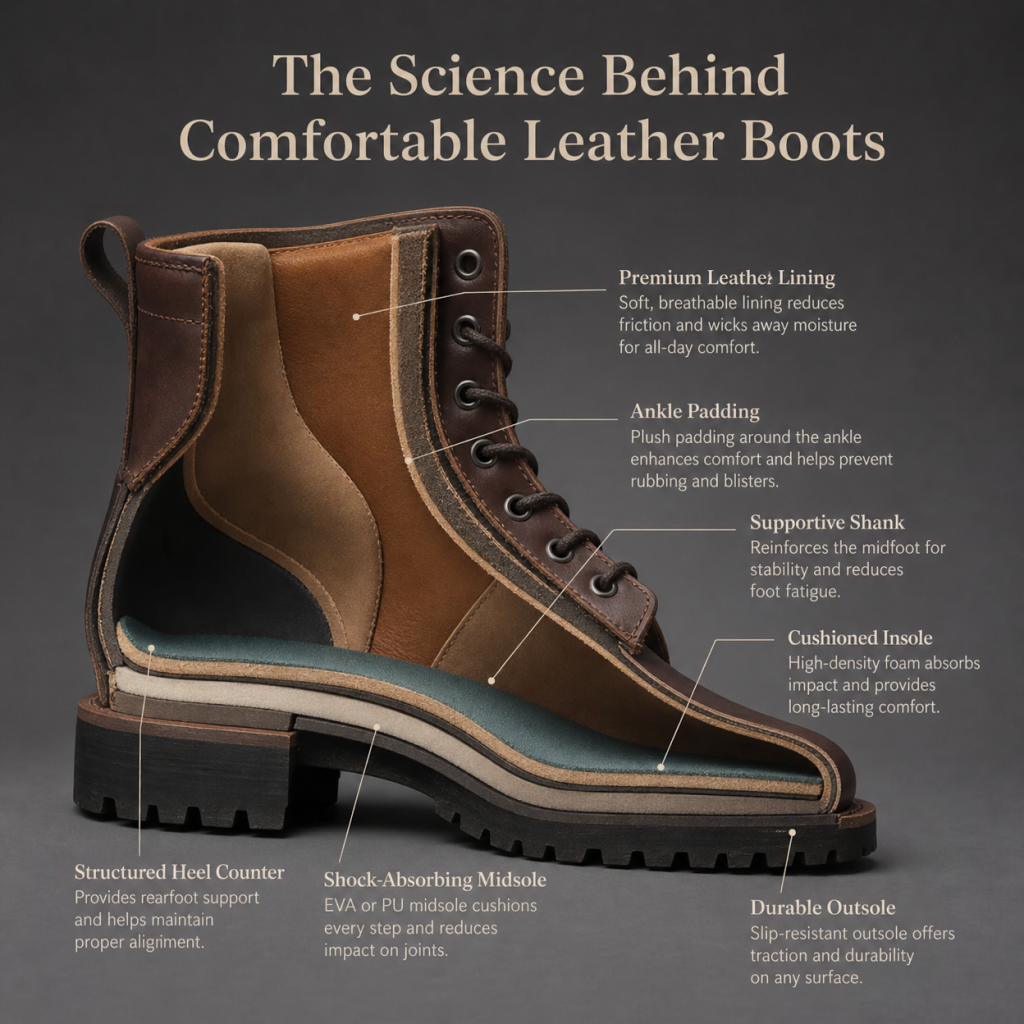
Comfort in leather boots isn’t random—it’s engineered. Every element of a well-designed boot, from the arch shape to the heel structure, is based on biomechanics, pressure distribution, and how the human foot behaves during movement. When boots feel “naturally comfortable,” it usually means the design has successfully aligned with foot science.
Understanding these principles helps you choose boots that don’t just look good, but actually support your body correctly over long periods of wear.
1. Foot Mechanics: The Foundation of Comfort
The human foot is a complex structure made of:
- 26 bones
- Over 30 joints
- Dozens of muscles, ligaments, and tendons
When walking, your foot cycles through impact, support, and push-off phases. If footwear interferes with this cycle, discomfort builds quickly.
Key principle:
A good boot doesn’t “control” your foot—it supports natural movement while controlling excessive stress.
Poorly designed boots often:
- Restrict natural flexing
- Misalign weight distribution
- Increase pressure in small foot areas
Well-designed boots do the opposite: they guide motion efficiently.
2. Arch Support and Weight Distribution
The arch is one of the most important structures in foot biomechanics.
What the arch does:
- Absorbs shock when stepping
- Distributes body weight evenly
- Stores and releases energy during movement
Without proper support, strain shifts to:
- Heels
- Forefoot (ball of foot)
- Plantar fascia (ligament under the foot)
Why arch support matters in boots
Good boots are designed to:
- Match natural arch curvature
- Reduce fatigue during long walking periods
- Prevent overpronation (foot rolling inward)
- Improve posture alignment
When support is not enough
Not all feet are identical. People with:
- Flat feet
- High arches
- Uneven gait patterns
may require:
- Orthotic insoles
- Custom support inserts
- Adjustable insole systems
A well-built boot provides a stable base, but personalization often completes the system.
3. Heel Height and Pressure Distribution
Heel height plays a major role in how weight is distributed across the foot.
Biomechanical impact:
- Higher heels → more pressure on forefoot
- Lower heels → more balanced weight distribution
Ideal range for comfort:
- 0.5 to 1.5 inches → optimal balance for most users
- Above 2 inches → increased pressure and fatigue risk
What happens with poor heel design:
- Forefoot pain during long standing
- Increased risk of joint strain
- Altered walking posture
- Reduced stability on uneven surfaces
Why boots often include a slight heel
A small heel in boots is intentional because it:
- Improves walking posture
- Reduces strain on Achilles tendon
- Adds shock absorption during heel strike
The goal is not height—it is controlled elevation for balance and support.
4. The Heel Counter: Stability and Injury Prevention
The heel counter is the rigid structure at the back of the boot that surrounds your heel.
Its main functions:
- Locks the heel in place
- Prevents excessive movement inside the boot
- Reduces friction (blister prevention)
- Improves overall stability during walking
Why it matters for comfort
If the heel moves too much:
- Skin rubs against the boot lining
- Blisters form
- Energy is wasted in unstable movement
A properly engineered heel counter:
- Feels firm but not painful
- Holds the heel securely
- Maintains alignment during motion
Signs of good heel counter design:
- Heel feels “locked in” without pressure points
- No slipping when walking uphill or downhill
- Stable support during quick direction changes
5. Insole Engineering: The Hidden Comfort Layer
While often overlooked, insoles are critical in comfort science.
What insoles do:
- Cushion impact forces
- Support arch structure
- Reduce pressure points
- Improve overall fit accuracy
Types of insole designs:
- Flat foam insoles → basic cushioning
- Contoured insoles → anatomical support
- Orthotic-grade insoles → corrective alignment support
Comfort principle:
A boot’s outsole provides structure, but the insole determines how your foot actually feels inside the boot.
6. Cushioning vs Stability: The Balance Problem
Comfort is not just softness. In fact, overly soft boots can cause instability.
Cushioning provides:
- Shock absorption
- Reduced pressure on joints
- Short-term comfort during walking
Stability provides:
- Proper alignment
- Controlled movement
- Reduced fatigue over time
The trade-off:
- Too soft → instability and fatigue
- Too stiff → pressure points and discomfort
The best boots find a balanced mid-point between both extremes.
7. Flex Points and Natural Movement
A well-designed boot bends at the same place your foot naturally flexes.
Natural flex zone:
- Located near the ball of the foot
- Where toes push off during walking
Why flex placement matters:
If a boot bends:
- Too far forward → restricts movement
- Too far back → causes arch strain
- In the wrong area → leads to discomfort and fatigue
Good leather boots:
- Flex naturally at the correct joint
- Maintain structure elsewhere for support
- Reduce energy waste during walking
8. Fit Science: Micro-Adjustments That Matter
Even perfect design fails if fit is incorrect.
Critical fit factors:
- Heel lock (no slipping)
- Toe space (not cramped, not too loose)
- Midfoot stability (secure but not tight)
- Volume balance (no excessive internal pressure)
Why small differences matter:
A few millimeters of space can determine:
- Whether blisters form
- How weight is distributed
- How long you can comfortably wear the leather boots
This is why boot sizing is more sensitive than sneaker sizing.
9. Material Behavior and Comfort Over Time
Leather is not static—it changes with use.
What happens during break-in:
- Fibers soften and relax
- Shape molds to foot structure
- Pressure points gradually reduce
- Movement becomes smoother
Why this matters:
A slightly stiff boot initially is often:
- Structurally stronger
- More durable long-term
- Capable of better long-term comfort
Comfort improves through adaptation, not just initial softness.
10. Temperature, Moisture, and Comfort Performance
Foot comfort is also affected by environmental factors.
Heat and moisture:
- Excess heat increases swelling
- Moisture causes friction and skin irritation
- Poor breathability leads to discomfort over time
Leather advantage:
High-quality leather:
- Allows controlled airflow
- Adapts to temperature changes
- Manages moisture better than synthetic materials
This is why premium leather boots often feel better over long wear sessions compared to synthetic alternatives.
Conclusion
Comfortable leather boots are the result of precise biomechanical engineering rather than chance. Every component—from arch support and heel height to heel counters and flex zones—works together to align with how the human foot moves and absorbs force.
The real science of comfort comes down to three principles:
- Proper weight distribution
- Controlled movement and stability
- Adaptation to natural foot mechanics
When these elements are correctly balanced, leather boots stop feeling like rigid footwear and start functioning as an extension of the body. That’s what separates average leather boots from truly well-engineered leather footwear—comfort that lasts not just minutes, but all day, every day.
