
Post
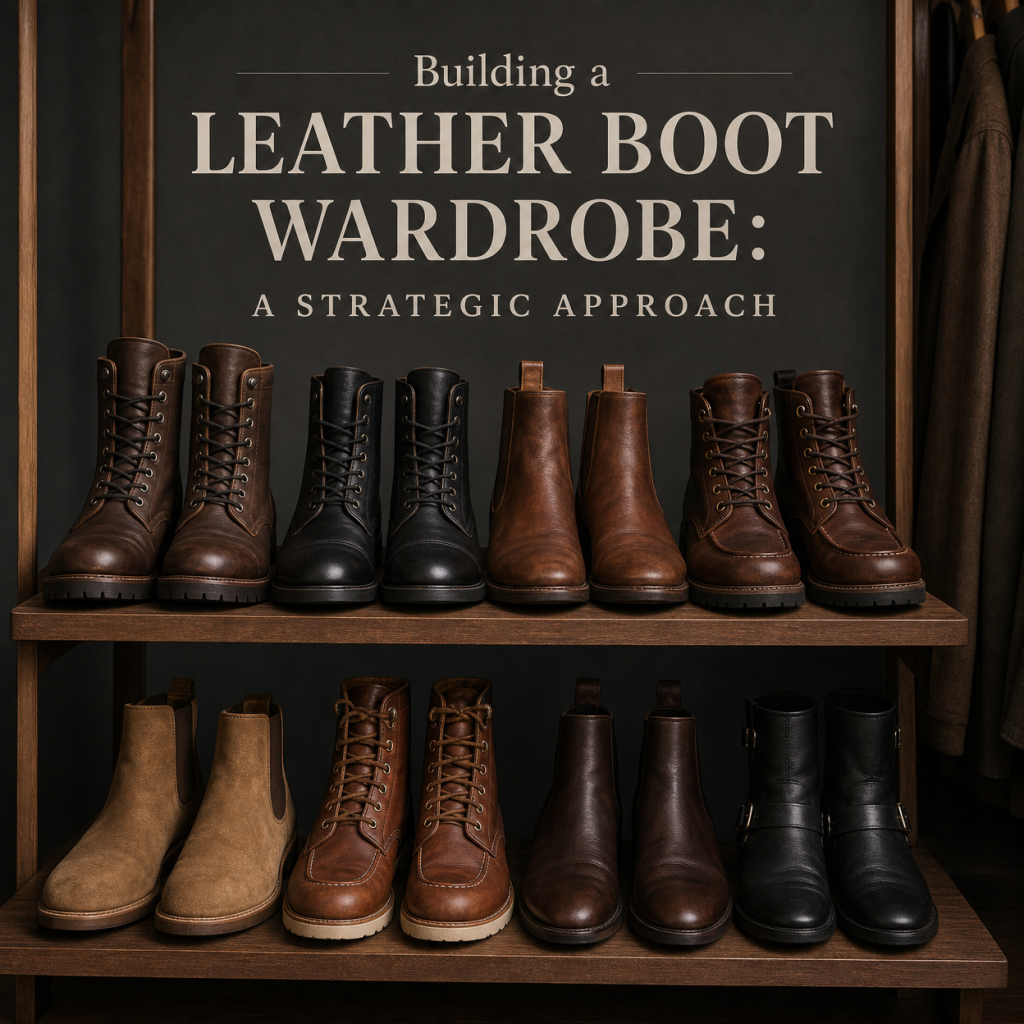
Building a Leather Boot Wardrobe: A Strategic Approach
May
Building a Leather Boot Wardrobe: A Strategic Approach
A leather boot wardrobe is not just a collection of footwear—it’s a structured system that supports your daily life across different environments, seasons, and dress codes. The difference between a “random collection” and a “strategic wardrobe” is consistency. One creates confusion and overspending, the other creates clarity, efficiency, and long-term value.
Instead of reacting to trends or buying leather boot when something looks good online, a strategic approach focuses on purpose. Every pair has a job, and no pair overlaps unnecessarily.
1. The Core Philosophy: Systems Over Shopping
Most people approach boots emotionally—buying what looks attractive in the moment. A strategic wardrobe removes that randomness.
A functional leather boot system is built on four principles:
- Coverage: every situation in your life is accounted for
- Versatility: each boot works in multiple outfits
- Durability: long-term wear is prioritized over short-term style
- Efficiency: minimal overlap between pairs
The result is a smaller, more powerful collection that performs better than a large, unfocused one.
2. Step One: Establish the Foundation (The “Core Two” Rule)
A strong wardrobe always starts with two foundational leather boot that handle 70–80% of daily use.
Black Chelsea leather boot (Primary Smart Boot)
The black Chelsea leather boot is the most efficient entry point into a structured boot wardrobe.
It works because it is:
- Minimal and clean in design
- Easy to wear with formal and casual outfits
- Suitable for office, meetings, and evenings
- Seasonless in most climates
This boot covers your “default smart look.” If you are unsure what to wear, this is the safest choice.
Use cases:
- Office and professional settings
- Smart casual outfits
- Evening events
- Minimalist fashion styling
Brown Everyday Boot (Primary Casual Boot)
The second foundation is a rugged or casual brown boot.
This could be:
- A lace-up leather boot
- A chukka boot
- A lightweight work-inspired boot
Its role is completely different from the Chelsea boot.
It handles:
- Daily errands
- Casual weekends
- Travel outfits
- Outdoor walking
Where the black Chelsea is structured and clean, the brown boot is relaxed and functional.
Together, these two boots create a complete base system: formal + casual covered.
3. Step Two: Add Seasonal Intelligence
Once the core is built, the next layer is climate adaptation.
Winter Boot (Protection Layer)
Winter boots are not optional in harsh climates—they are functional protection.
Key features:
- Insulated lining (wool, fleece, thermal layers)
- Waterproof or water-resistant leather
- Thick traction soles
- Reinforced structure for cold conditions
Use cases:
- Rain, snow, and freezing conditions
- Long outdoor exposure
- Cold-weather commuting
A winter boot prevents damage not only to your footwear but also discomfort and injury risks.
Summer / Lightweight Boot
Warm climates require a completely different approach.
Ideal options:
- Lightweight suede boots
- Thin leather chukkas
- Breathable ankle boots
Benefits:
- Reduced heat retention
- Better airflow
- Lower fatigue during long wear
Summer boots are about comfort and breathability, not heavy durability.
Transitional Boots (Spring / Autumn)
These are your most flexible months, where most boots rotate freely.
Best choices:
- Chelsea boots
- Lightweight lace-up boots
- Neutral ankle boots
These seasons allow maximum wardrobe creativity because weather is balanced.
4. Step Three: Expand with Purpose-Based Additions
After covering basics and seasons, expansion should solve specific gaps—not add repetition.
Dress Boot (Formal Upgrade Option)
If your lifestyle includes formal environments, a dedicated dress boot is valuable.
Characteristics:
- Slim silhouette
- Polished leather finish
- Minimal stitching and detailing
- Slightly refined toe shape
Use cases:
- Business formal environments
- Events and presentations
- Smart evening outfits
This boot bridges the gap between leather shoes and boots.
Heavy-Duty Work Boot (Functional Specialist)
For physically demanding lifestyles, a work boot is essential.
Features:
- Reinforced toe protection
- Thick leather construction
- Oil/slip-resistant soles
- Maximum durability focus
Use cases:
- Industrial work
- Construction environments
- Heavy outdoor activity
This is a “tool,” not a fashion piece.
Style-Focused Boot (Optional Expression Piece)
Once essentials are covered, a statement boot can be added for personality.
Examples:
- Brogue boots
- Distressed leather boots
- High-detail fashion boots
This pair should never replace functional boots—it enhances personal style variety.
5. Building a Capsule Boot Wardrobe
A capsule wardrobe focuses on minimal but complete coverage.
Ideal 4–5 Boot System
A balanced setup might include:
- Black Chelsea boot → smart + formal base
- Brown everyday boot → casual daily use
- Lightweight suede or tan boot → seasonal versatility
- Winter waterproof boot → climate protection
- Optional dress or statement boot → refinement or personality
This system ensures:
- No missing scenarios
- No duplicate functionality
- Full seasonal coverage
6. Color Strategy: The Hidden Structure
Color is what ties the entire wardrobe together.
Core color system:
- Black → formal and structured
- Dark brown → everyday versatility
- Tan / light brown → seasonal contrast
Why it matters:
- Makes outfit pairing easier
- Prevents visual redundancy
- Creates intentional styling hierarchy
- Improves wardrobe cohesion
A wardrobe with too many similar shades often feels repetitive, even if the boots are high quality.
7. Rotation Strategy: Protecting Your Investment
Even the best boots degrade if overused.
Why rotation matters:
- Leather needs recovery time
- Moisture evaporates between uses
- Soles wear more evenly
- Comfort remains consistent over years
Simple rotation method:
- Smart boot (Chelsea) → 2–3 days/week
- Casual boot → alternating daily use
- Seasonal boot → condition-based use only
This extends lifespan significantly without extra effort.
8. Maintenance Integration: Long-Term Strategy
A boot wardrobe is not complete without maintenance planning.
Essential habits:
- Clean after heavy dirt exposure
- Condition every few months depending on climate
- Use waterproofing in wet seasons
- Store with shape support (boot trees or stuffing)
Why this matters:
A strategic wardrobe assumes boots will last 5–15+ years. Maintenance is what turns that assumption into reality.
9. Budget Strategy: Smarter Spending Over Time
A structured wardrobe does not require buying everything at once.
Recommended approach:
- Start with 1–2 core boots
- Add seasonal boots as needed
- Upgrade quality over time instead of increasing quantity
- Replace weak boots instead of accumulating them
Common mistake:
Buying 5 average boots instead of 2 high-quality ones.
Quality always compounds better than quantity.
10. Travel Boot Capsule Strategy
For frequent travelers, boots must be minimal and versatile.
Ideal travel setup:
- 1 Chelsea boot (smart + casual)
- 1 lightweight casual boot (comfort focus)
This reduces luggage while maintaining outfit flexibility.
11. Common Wardrobe Mistakes to Avoid
1. Overlapping boots
Multiple boots doing the same job adds no value.
2. Ignoring lifestyle reality
Buying fashion boots that don’t match daily use.
3. Seasonal imbalance
Heavy boots in summer or light boots in winter.
4. No maintenance system
Even premium boots fail without care.
5. Impulse expansion
Adding boots without identifying missing roles.
12. Long-Term Evolution of Your Wardrobe
A good boot wardrobe is not static—it evolves.
Over time, you may:
- Replace entry-level boots with higher quality versions
- Shift style preference toward minimal or rugged designs
- Adjust seasonal coverage based on climate changes
- Reduce quantity while increasing quality
The end goal is not more boots—it’s better alignment between your lifestyle and your footwear system.
Conclusion
A leather boot wardrobe should function like a carefully designed toolkit. Each boot has a specific job, and together they create a complete system that adapts to your work, lifestyle, weather, and personal style.
When built strategically, you no longer think in terms of “which boots should I wear today?” Instead, you rely on a system where every choice is already optimized.
The real value of a boot wardrobe is not how many pairs you own—but how effortlessly those pairs work together to support your daily life for years, even decades, with consistency and confidence.
