
Post
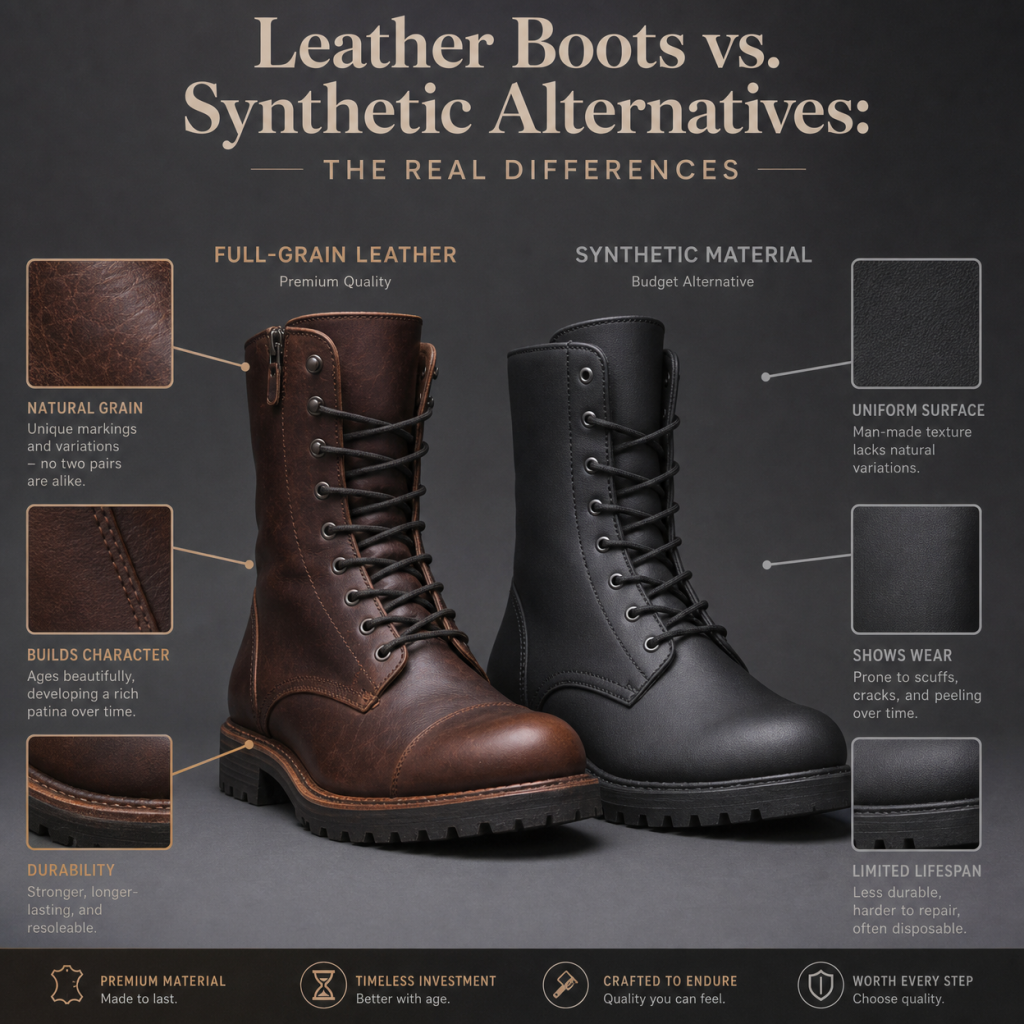
Leather Boots vs. Synthetic Alternatives: The Real Differences
May
Leather Boots vs. Synthetic Alternatives: The Real Differences
The footwear market today offers two dominant options: traditional leather boots and modern synthetic alternatives. At first glance, many synthetic boots closely resemble leather in appearance and are often marketed as cheaper, more practical, or more “ethical” alternatives. However, the real differences go far deeper than looks.
Choosing between leather and synthetic boots is not just a style decision—it affects durability, comfort, long-term cost, maintenance requirements, and even environmental impact depending on usage patterns. Understanding how these materials behave in real-world conditions helps you choose footwear that actually matches your needs rather than marketing claims.
Durability: Long-Term Strength vs Short-Term Use
One of the most important differences between leather and synthetic boots is lifespan.
Leather Durability
High-quality leather boots are known for exceptional longevity. With proper care, they can last:
- Many years of regular use
- Decades in some cases
- Multiple resoling cycles
Leather fibers are naturally strong and flexible, which allows them to withstand repeated stress without quickly breaking down.
Key durability advantages include:
- Resistance to tearing when properly maintained
- Ability to soften rather than degrade over time
- Structural integrity that improves with conditioning
- Long service life under varied conditions
Synthetic Material Durability
Synthetic boots are typically made from materials like:
- Polyurethane (PU)
- PVC-based compounds
- Synthetic leather composites
While they may perform well initially, they tend to:
- Wear out faster under heavy use
- Crack or peel over time
- Lose structural integrity after prolonged exposure to heat and moisture cycles
- Show visible degradation rather than gradual aging
In most cases, synthetic boots are designed for shorter product lifecycles.
Key Difference
- Leather = long-term investment
- Synthetic = short-to-medium term replacement product
Repairability: A Major Structural Advantage of Leather
Another critical difference is whether boots can be repaired.
Leather Boots Can Be Repaired
One of leather’s greatest strengths is repairability. Depending on construction (especially Goodyear welted boots), leather footwear can often be:
- Resoled
- Re-heeled
- Restitched
- Reconditioned
This means the upper part of the boot can remain intact while worn-out components are replaced.
This significantly extends usable lifespan and reduces long-term cost per wear.
Synthetic Boots Are Hard to Repair
Synthetic boots typically:
- Cannot be effectively resoled
- Have glued construction that is difficult to separate
- Break down structurally rather than wear gradually
- Are often cheaper to replace than repair
Once a synthetic boot fails, it is usually discarded rather than restored.
Aging and Appearance Over Time
How boots age is another major distinction.
Leather: Improves With Age
Leather develops something called patina—a natural change in color, texture, and character over time.
This results in:
- Richer color depth
- Softer texture
- Unique visual character
- A “lived-in” premium look
Instead of degrading, leather often becomes more visually appealing with use.
Each pair becomes slightly unique based on how it is worn.
Synthetic Materials: Degradation Over Time
Synthetic boots generally do not improve with age. Instead, they tend to:
- Fade in color
- Crack at stress points
- Peel or flake on the surface
- Lose their original finish
The aging process is usually seen as deterioration rather than enhancement.
Breathability and Comfort
Comfort over long periods is heavily influenced by how a material handles heat and moisture.
Leather Breathability
Leather is a naturally porous material. This allows it to:
- Release moisture vapor
- Adapt to temperature changes
- Reduce internal heat buildup
- Conform gradually to foot shape
As a result, leather boots often become more comfortable over time as they mold to the wearer’s foot.
Synthetic Limitations
Most synthetic materials:
- Trap heat inside the boot
- Reduce airflow
- Increase sweat buildup
- Can feel “plastic-like” during long wear
This often leads to discomfort in warm or humid conditions.
Hybrid Solutions
Some high-end synthetic boots use:
- Waterproof membranes (e.g., breathable liners)
- Engineered ventilation systems
While these improve performance, they also increase complexity and cost, and still may not fully match natural leather comfort.
Water Resistance and Weather Performance
Both materials handle water differently.
Leather Performance
- Naturally water-resistant (to a degree)
- Can be treated for improved waterproofing
- Requires maintenance for best performance
- Can absorb water if untreated
With proper care, leather performs very well in varied weather conditions.
Synthetic Performance
- Often fully waterproof initially
- Does not require conditioning
- Resistant to immediate water penetration
However, once synthetic materials degrade, waterproof performance can decline rapidly and permanently.
Comfort Over Time
Leather: Improves With Wear
Leather boots gradually adapt to the wearer’s foot shape. Over time, they:
- Reduce pressure points
- Become more flexible
- Provide customized fit
- Improve walking comfort
This personalization effect is one of leather’s strongest advantages.
Synthetic: Fixed Structure
Synthetic boots generally:
- Do not significantly change shape
- Maintain the same stiffness over time
- May become less comfortable as materials age
They do not “break in” in the same meaningful way as leather.
Environmental Considerations
The environmental comparison between leather and synthetics is complex and depends on perspective.
Leather Considerations
Leather comes from animal agriculture, which involves:
- Land use
- Water consumption
- Methane emissions
- Chemical tanning processes
However, leather boots:
- Last significantly longer
- Can be repaired and resoled
- Reduce need for frequent replacement
This long lifespan can reduce overall consumption over time.
Synthetic Considerations
Synthetic boots are typically derived from:
- Petroleum-based materials
- Industrial chemical processes
They often:
- Have lower initial environmental cost per unit
- But shorter lifespan increases waste frequency
- Are harder to recycle or repair
Key Insight
- Leather = higher durability, lower replacement frequency
- Synthetic = lower initial impact, higher turnover rate
The environmental outcome depends heavily on usage duration and replacement habits.
Cost Over Time: Short-Term vs Long-Term Value
Leather Boots
- Higher upfront cost
- Lower cost per year over time
- Can be repaired instead of replaced
- Often become more valuable with age
Synthetic Boots
- Lower initial cost
- Higher replacement frequency
- No repair value
- Higher long-term cost in frequent use scenarios
In practical terms, leather often becomes more economical over long-term use.
Style and Aesthetic Value
Leather
- Natural texture and grain
- Unique imperfections
- Rich patina development
- Timeless appearance
Leather is widely considered more premium and versatile in styling.
Synthetic
- Uniform appearance
- Less natural variation
- Can mimic leather initially
- May lose visual quality over time
Synthetic boots often look “new” for a shorter period.
Conclusion
Leather boots and synthetic alternatives each serve different needs, but they are fundamentally different in performance, lifespan, and long-term value.
Leather stands out for its durability, repairability, breathability, and ability to age beautifully. It is a material designed for long-term use, often improving in comfort and appearance over time.
Synthetic boots offer affordability, consistent water resistance, and lower entry cost, making them suitable for short-term or occasional use.
The real decision comes down to usage patterns:
- For long-term investment, daily wear, and durability → leather is superior
- For short-term use, budget constraints, or occasional wear → synthetics may be practical
Ultimately, leather boots are not just footwear—they are long-term companions that evolve with the wearer, while synthetic boots are typically functional tools designed for shorter lifecycles.
